South-west wastewater upgrade
Delivering new infrastructure to support population growth.
Duration
2015 - ongoing
Location
Waiuku, Glenbrook, Clarks Beach, Kingseat
Status
Planning
Project overview
As the south-west of Auckland develops, we are investing in our wastewater treatment infrastructure to support population growth in Waiuku, Glenbrook Beach, and Clarks Beach. We are protecting the environment while enabling growth.
At the same time, the treatment plants currently serving these communities are coming to the end of their operational life, just as the area is experiencing considerable population growth.
To meet this challenge, we are upgrading our Clarks Beach and Waiuku sites to enable them to service up to 30,000 people. This will include:
- New, upgraded wastewater treatment plants (WWTPs) on our existing sites at Waiuku and Clarks Beach, using the latest membrane bio reactor (MBR) and membrane aerated bio reactor technology (MABR).
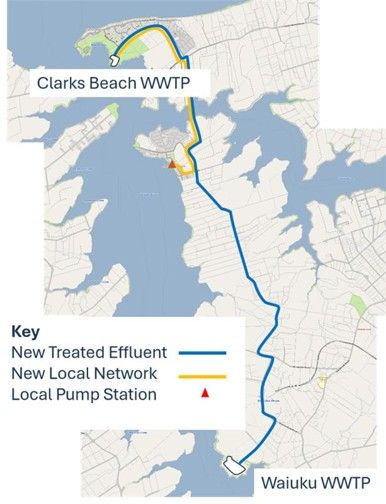
- A new 710mm diameter pipeline to carry treated wastewater from Waiuku to Clarks Beach, running alongside Williams Road, Mission Bush Road, Glenbrook Beach Road, McLarin Road, under the Taihiki River and then Clarks Beach Road.
Beyond 2050
Based on Auckland Council’s current population growth projections, will support growth to 2050.
Beyond this, we have the option of transitioning to a centralised wastewater treatment plant at our Waiuku site. This would involve constructing a new pipeline to carry untreated wastewater from Clarks Beach to Waiuku, expanding the Waiuku WWTP site, and decommissioning most of the Clarks Beach WWTP site.
What is happening now
Clarks Beach
- A new WWTP delivering higher quality treated effluent is now in operation
- A new Outfall dispersing high-quality treated effluent on the outgoing tide is now in operation
- Design for a permanent tidal storage structure that will hold treated wastewater from both the Clarks Beach and Waiuku WWTP sites is well underway with Construction starting in 2027.
The site is located next to the Clarks Beach Golf Club, and the team are very grateful for the club’s cooperation and patience.
The plant uses the latest technology to treat wastewater, to find out more click here.
Waiuku
The existing plant, located near the Glenbrook steel mill, treats wastewater from people in Waiuku. The upgrades now underway, like the new plant at Clarks Beach, use the latest technology to treat wastewater.
- The team are installing new Membrane Aerated Bio Reactor tanks which use naturally occurring microorganisms to break down contaminants. They are not only more effective at decontaminating the wastewater, they also use less energy.
- Design of a new pump station to convey the high-quality treated effluent to Clarks Beach is well underway and once completed will take treated wastewater from Waiuku to be discharged at Clarks Beach on the outgoing tide. This allows the old outfall at Waiuku to be turned off.
The Conveyance Pipework
- The pipe that will take treated wastewater from Waiuku to Clarks Beach is a treated effluent conveyance pipe.
- The pipe that will take raw wastewater from the pump station at Fleet Street to the Clarks Beach WWTP is a local network pipe.
The team are in preparatory stages for construction, with the design complete on both pipes and stakeholders being consulted about both the design and the construction.
There are a number of businesses along the route of the conveyance and careful planning has gone into minimising the risks of any damage or disruption.
History
There was a previous plan to replace the separate treatment plants at Waiuku and Clarks Beach with a larger one located on Glenbrook Beach Road. However, following consultation this will not take place. The Watercare land at 372 Glenbrook Beach Road will be used as a laydown area during construction. Works at this site to date have included the restoration of a natural flow path.
Our Historical Decision Making Process
The options assessed included using our existing wastewater treatment plant sites at Waiuku and Clarks Beach, a new treatment plant on one of two new sites on NZ Steel owned land at Waiuku, or a new plant at 372 Glenbrook Beach Road.
In February 2025, we held drop-in sessions in Waiuku, Clarks Beach and Glenbrook Beach to discuss this list with the community.
The options were then evaluated and in March 2025, we held community drop-in session to talk about the short list of options. In July we returned to present our choice to make considerable upgrades to the existing facilities and connecting Waiuku to Clarks Beach.
Project FAQs
Project FAQs
What is the history of the project?
As the south-west of Auckland develops, we need to expand our wastewater treatment infrastructure to support population growth. The treatment plants currently serving these communities are coming to the end of their operational life and the area is growing. We are developing a long-term solution that will support growth through to 2050.
Our plan has previously been to replace these plants with one larger facility that can meet the needs of 30,000 people. In 2023, we purchased land in Glenbrook and lodged a Notice of Requirement with Auckland Council to designate it for wastewater treatment purposes.
Council referred it to a panel of independent commissioners for assessment under the Resource Management Act 1991.
In late May 2024, the panel of independent commissioners recommended we withdraw our Notice of Requirement. After reviewing the commissioners’ feedback, we decided not to pursue the designation of our land in Glenbrook for wastewater treatment purposes.
We reassessed our options for wastewater servicing in the area, responding to community and commissioner feedback. The options assessed included using our existing wastewater treatment plant sites at Waiuku and Clarks Beach, a new treatment plant on one of two new sites on NZ Steel owned land at Waiuku, or a new plant at our previously preferred site at 372 Glenbrook Beach Road.
A longlist of eight options was developed, across five possible sites. In February 2025, Watercare held drop-in sessions in Waiuku, Clarks Beach and Glenbrook Beach to discuss this longlist with the community.
Options were then evaluated using multi-criteria analysis (MCA). This involved looking at the pros and cons of each option against a wide range of criteria, such as:
- Heritage
- Social and community
- Natural environment
- Landscape/ visual
- Highly productive land
- Constructability
- Operability
- Greenhouse gas emissions
- Reuse of treated effluent
In March 2025, we held community drop-in session to talk about the short list of options before revisiting the MCA.
What is our preferred wastewater servicing solution?
The preferred solution is a decentralised scheme utilising our existing Clarks Beach and Waiuku sites that will service up to 30,000 people. This will include:
- New, upgraded wastewater treatment plants (WWTPs) on our existing sites at Waiuku and Clarks Beach
- A new pipeline to carry treated wastewater from Waiuku to Clarks Beach
- A new pipeline to carry raw wastewater from the Fleet Street Pump station to Clarks Beach
- Tidal storage on our Waiuku and Clarks Beach WWTP sites.
This option will provide capacity for up to 30,000 people, and based on Auckland Council’s current population growth projections, will support growth to 2050.
Beyond this, Watercare has the option of transitioning to a centralised wastewater treatment plant at our Waiuku site. This would involve constructing a new pipeline to carry untreated wastewater from Clarks Beach to Waiuku, expanding the Waiuku WWTP site and decommissioning most of the Clarks Beach WWTP site.
Transitioning to a new expanded plant in Waiuku would be dependent on the population reaching 30,000 and is not predicted to happen till after 2050.
Why was this option chosen?
As well as reflecting the views of the community and their priorities this staged plan also makes best use of the existing system, provides more flexibility and lower upfront costs.
What is happening now?
Clarks Beach
The plant is located next to Clarks Beach Golf Club.
A new WWTP delivering higher quality treated effluent is now in operation
A new Outfall dispersing high-quality treated effluent on the outgoing tide is now in operation
Design for a permanent tidal storage structure that will hold treated wastewater from both the Clarks Beach and Waiuku WWTP sites is well underway with Construction starting in 2027.
Waiuku
The existing plant, located near the Glenbrook steel mill, treats wastewater from people in Waiuku.
The team are installing new Membrane Aerated Bio Reactor tanks, undertaking power and UV upgrades, as well as building a new access road into the site.
The result will be high quality treated effluent that can be stored with the Clarks Beach treated effluent before being discharged at Clarks Beach on the outgoing tide. This has minimal impact on the local environment.
Works commenced in Mid-February 2026 with the first stage, commissioning the new treatment tanks forecast for completion in 2027.
What about Kingseat?
In the initial stages of the project the area of Kingseat was considered part of the project’s catchment, however while there is expected to be growth in the area, the developers involved have opted to provision their own wastewater infrastructure, and the existing services are adequate for the near future.
Further development of the infrastructure would require investment from developers, and this has not been forthcoming. Unfortunately, it would not be economically feasible to connect Kingseat to the new infrastructure being built for Waiuku and Clarks Beach.
Why the Waiuku Channel and not the Tasman Sea?
Watercare was granted resource consent by the Environment Court in 2018 to discharge treated wastewater into the Waiuku Channel on the outgoing tide, at a location adjacent to the Clarks Beach Golf Course, for a 35-year period.
In 2016, an Assessment of Alternatives Report for the discharge consent identified a long list of approximately 137 options with different discharge locations, treatment technology and treatment plant locations. Seven of the thirty four short listed options were taken to the detailed analysis stage. Two of these options involved a discharge to the Tasman Sea.
Neither of the Tasman Sea options was identified as our preferred option due to:
- The difficult and complex nature of constructing an outfall in a highly dynamic coastal environment.
- Discharging to the Tasman Sea would prevent beneficial reuse options of the treated effluent in the future.
- While the Tasman Sea options provided high dilution for the treated effluent, a majority of iwi opposed the Tasman Sea options.
Do you need to extend the Waiuku WWTP discharge consent while construction is underway?
Yes, Watercare will apply for a short-term renewal for the discharge from the Waiuku WWTP. Only once the treated effluent pipework is commissioned and the permanent tidal storage at Clarks Beach is complete will the team be able to turn flows north.
At this point treated effluent will be pumped from the Waiuku WWTP to Clarks Beach and the existing outfall at Waiuku becomes redundant and will be removed from use.
How much is this going to cost?
Watercare is yet to agree a price for the conveyance contract. Costs are currently forecast to be less than $500m.
How will this impact our community?
Watercare is limiting wastewater treatment to our existing operational WWTP sites. In addition, the work to build a pipe between Waiuku and Clarks Beach along Glenbrook Beach Road is being carefully planned to minimise disruption to road users and local businesses and residents.
Once the works are complete, better quality treated effluent will be dispersed more effectively into the marine environment resulting in significantly less environmental effects.
How will you build new plants on existing sites and keep them operating?
Watercare will be installing temporary treatment facilities to ensure that we meet our existing consents conditions while the construction of the new WWTPs is undertaken.
What are we doing with the Glenbrook site?
We have restored the natural flow path on this site. In the short term will use the site as a temporary laydown area as well as for agricultural purposes.